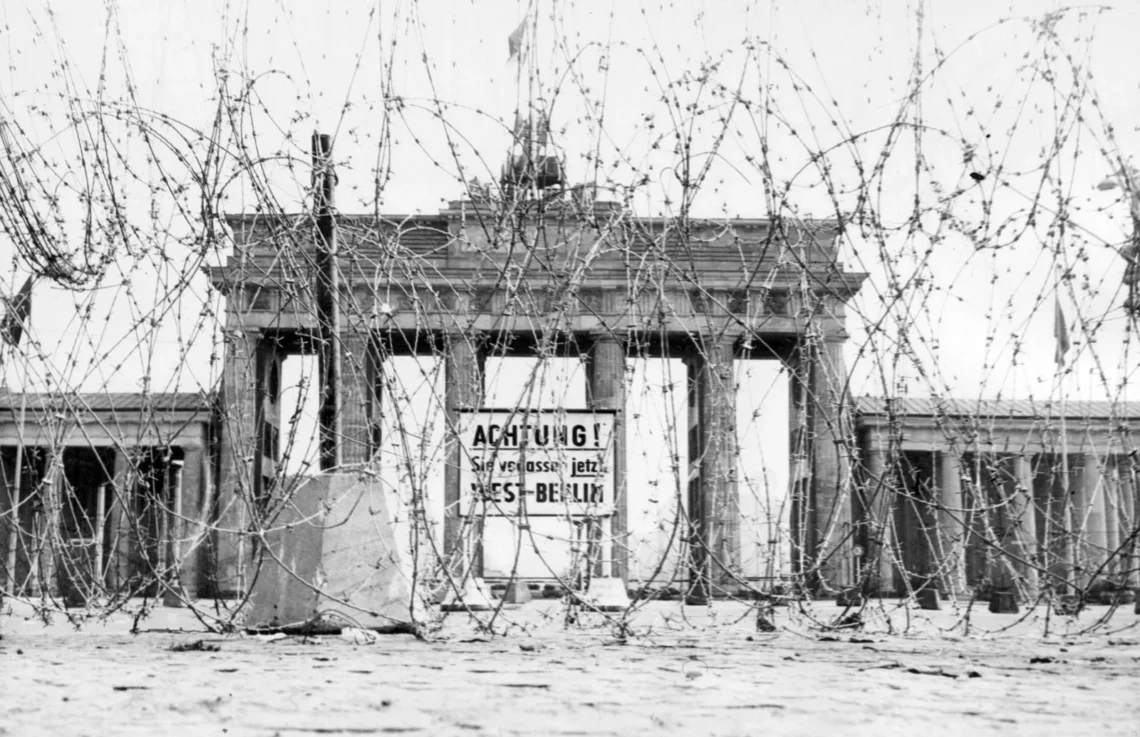
The New Iron Curtain
Those who view modern diplomacy through the narrow lens of transaction – defence deals, trade targets, agreements signed – the recent visit of President Vladimir Putin to India might seem just another headline. But to understand its gravity, we have to go back nearly eighty years to a small-town named Fulton in the heart of American Midwest. There stands a place where a prescient warning bell was rung by a titan of the old world intending to wake a Post-War generation from drifting into a dangerous, optimistic sleep.
It was here, on the 86-acre campus of Westminster College in 1946, Sir Winston Churchill delivered his famous ‘Iron Curtain’ speech referring to the symbolic barrier between Soviet and Western blocs. Draped in the scarlet Oxford professor’s robe, standing alongside then US President Harry S. Truman within the walls of the Westminster Gymnasium, he began by telling the Americans that they stand at the “pinnacle of world power” and warned that the primacy calls for “an awe-inspiring accountability for the future” and that to “reject it or ignore it or fritter it away will bring upon us all the long reproaches of a lifetime.” Before referring to the Iron Curtain, he firstly went on to praise the valour of the Russian people and highlighted the sense of comradeship that prevails after the Allied victory in the second World War. He expressed a desire for a lasting friendship with Russia despite their differences, welcoming Russia to her “rightful place in the among the leading nations of the World.”
For those unaware of this speech or its context upon which I am laying emphasis, a rather dramatized but accurate reference can be found in the popular Netflix series – The Crown (S1E7). There, Churchill tells a young Queen Elizabeth II in their private audience:
“Russia is a great old empire which demands and deserves respect. Americans like to wave the big stick and speak with a loud voice—in the matters of world governance—they’re not yet ready.”
While mainstream history remembers Churchill’s speech as the bugle call for the Cold War, a deeper independent reading reveals the hidden truth. Churchill understood that Russia was not a problem to be solved but a permanent civilisational force to be engaged. For decades, the United States ignored this warning, choosing instead a path of confrontation in a quest for unipolar dominance. Under the banner of “American exceptionalism”, Washington toppled Governments, intervened in sovereign affairs and aided rogue forces (e.g. Pakistan) – all while vilifying Russia for using the very same tactics the West had already mastered. Yet, it was always others who broke the rules and not the America-led West. Since they had set the rules in the first place as per their needs. Even a departure from their own rules would be justified in the name of high principles – Democracy, Freedom, Global Peace!
Post Covid, the myth of American Exceptionalism was shattered. It was already teetering after the rise of China and various other global headwinds. An assertive India under PM Modi further led to the cracking of the myth. Donald Trump delivered the final, unyielding, blow. Through his ‘tariffs’ and ‘America First’ mandates, he lifted the cloak, revealing a superpower that is fluctuating, deeply divided, and transparently transactional. To the keen observer, the cloak was already thinning under Bush and Obama, but Trump simply made its removal permanent.
When the world saw PM Modi arriving together with President Putin in the SCO Summit to meet President Xi Jinping, a realisation was taking shape that now a ‘New Iron Curtain’ has been drawn with American hegemony and a confused Europe on one side and those challenging the hegemony on the other side. The West was definitely not going to let this realisation spread its wings.
Even before President Putin landed in New Delhi on 4th December, the West had already planted the seeds of chaos in India. On 1st December, Times of India (TOI) published an article written by envoys of Germany, France and UK unilaterally blaming Russia for the Ukraine war. On the very next day, Indian Express published an interview of Deputy FM of Poland known for his invariable hatred for Russia and was asked what he expected India to convey to President Putin. These are just two examples in the Indian media. Several other ‘experts’ on talk shows and news columns subtly seeded the idea that a relationship with Russia shall be detrimental to India’s ties with the West. Some chose to specifically target Russian military equipment, considering them to be the ‘glue’ to traditional India-Russia ties. A U.S. news outlet published an article titled, “Sorry Russia, India doesn’t want your 5th Gen. Fighter.” Many similar attempts were made to draw attention to the absence of big-ticket defence deals signed during his visit and downplay it as mere optics. Frantic statements came from across the world blaming Trump’s tariffs that pushed India closer to Russia.
While an array of agreements were signed across various sectors during the visit, we shall not delve into them as they are secondary to the diplomatic reality they represent. The hidden truth is that the ‘New Iron Curtain’ is here to stay. This time India stands at the platform where UK stood post WWII. However, unlike then, our relationship with Russia is built upon the foundation of strong mutual trust, an open dialogue and collaboration as equal partners. We engage with Russia at all levels of shared strategic arenas, despite the differences on various aspects including her relationship with nations like China and Turkey. We recognise that those are our battles to fight – not Russia’s. A Russian diplomat recently captured this perfectly:
“What we like is that Prime Minister Modi and our Indian counterparts want to listen to our position… it gives us a possibility to explain ourselves. This ensures mutual understanding… For example, we do not speak with the Europeans, we don’t have a dialogue… even a word… so how can you learn your counterpart’s position… when you don’t speak to each other? This is the greatest problem we have! But with India it is vice-versa.”
At the same time, India has not indulged in any attempt to sabotage the West or re-write the rules in our favour. We respect the boundaries of sovereignty and have the ability to adapt to the new global order. This “new Iron Curtain”, is therefore, a result of the West’s refusal to accept that the world is now officially in the multi-polar era.
Tailpiece:
The India-Russia Special and Privileged Strategic Partnership is not a legacy driven association, but is rather the most resilient and multi-dimensional alliance for decades to come. As the world reorders itself, India stands as the bridge. We will remember Churchill’s warning, continuing to engage even with a declining West, until the heat of Indian leadership eventually melts the new iron curtain away.

One Comment
Raj
Nicely put it and truly captures the essence of the point